

Mars Self-Driving Milestone
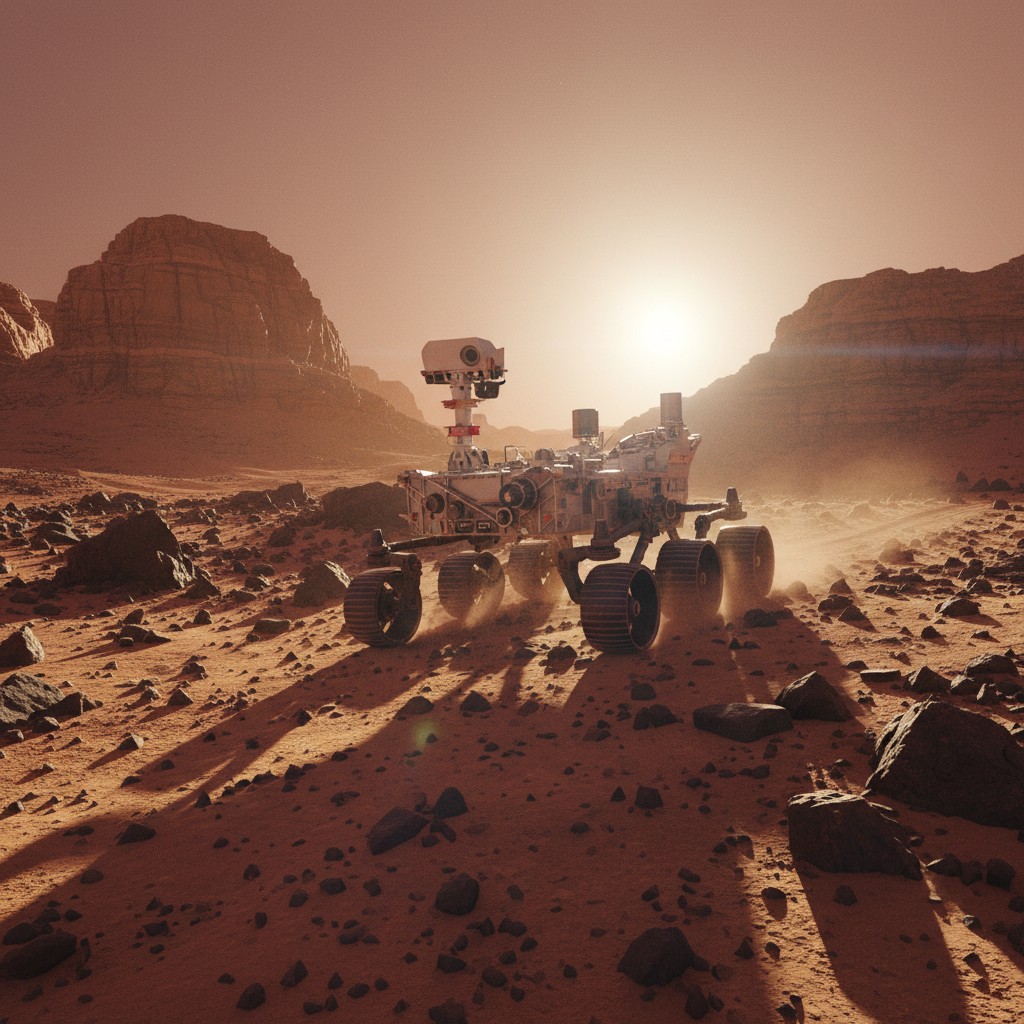
Illustration, not documentary evidence of the event.
The successful deployment of autonomous driving technology on Mars marks a significant milestone in the history of space exploration. With roughly 90 percent of the distance driven by Perseverance being autonomous, this achievement demonstrates the feasibility and reliability of self-driving vehicles in harsh, extraterrestrial environments. This breakthrough has far-reaching implications for the future of Mars exploration and the development of autonomous vehicle technology for use on Earth.
Technical Deep Dive
Autonomous driving on Mars requires a complex interplay of sensors, software, and hardware. The Perseverance rover is equipped with a suite of sensors, including cameras, lidar, and radar, which provide a 360-degree view of its surroundings. This sensor data is then processed using sophisticated software algorithms that enable the rover to navigate and avoid obstacles. The rover's autonomous driving system is based on a combination of mapping, localization, and motion planning techniques, which allow it to build and update a map of its environment and plan its route accordingly.
The use of autonomous driving technology on Mars also presents unique technical challenges, such as dealing with the planet's harsh terrain, limited communication with Earth, and the need for redundant systems to ensure reliability. To overcome these challenges, the Perseverance rover's autonomous driving system is designed to be highly flexible and adaptable, with the ability to adjust its navigation and control parameters in real-time based on changing environmental conditions.
Industry Impact
The success of autonomous driving on Mars is likely to have a significant impact on the development of autonomous vehicle technology for use on Earth. The technologies and techniques developed for Mars exploration can be applied to a wide range of terrestrial applications, from self-driving cars to autonomous drones. The experience and expertise gained from developing and deploying autonomous driving technology on Mars can also be used to improve the safety and efficiency of autonomous vehicles on Earth. autonomous vehicles offers additional context on this topic.
The achievement of autonomous driving on Mars also highlights the importance of collaboration and knowledge sharing between the space and automotive industries. The development of autonomous vehicle technology is a complex and multidisciplinary challenge that requires the expertise of engineers and researchers from a wide range of fields, including computer science, mechanical engineering, and electrical engineering. By working together and sharing knowledge and expertise, the space and automotive industries can accelerate the development of autonomous vehicle technology and overcome the technical and regulatory challenges that stand in its way.
Market Structure Analysis
The success of autonomous driving on Mars is likely to lead to increased investment and funding for autonomous vehicle technology, both in the space and automotive industries. This could lead to the establishment of new companies and partnerships focused on the development and deployment of autonomous vehicle technology, as well as the expansion of existing companies into new markets and applications. The achievement of autonomous driving on Mars could also lead to changes in the regulatory environment, with governments and regulatory agencies taking a more favorable view of autonomous vehicle technology and its potential applications.
The market for autonomous vehicle technology is likely to be highly competitive, with a wide range of companies and organizations vying for market share and dominance. The space industry is likely to play a significant role in the development and deployment of autonomous vehicle technology, with companies such as NASA and SpaceX leading the way. The automotive industry is also likely to be a major player, with companies such as Waymo and Tesla investing heavily in autonomous vehicle technology.
Frequently Asked Questions
How does the autonomous driving technology on Mars compare to autonomous vehicle technology on Earth?
The autonomous driving technology on Mars is designed to operate in a much more challenging environment than autonomous vehicle technology on Earth. The Martian terrain is much more rugged and unforgiving than most roads on Earth, and the communication delay between Mars and Earth means that the rover must be able to operate independently for long periods of time. Despite these challenges, the autonomous driving technology on Mars shares many similarities with autonomous vehicle technology on Earth, including the use of sensors, software, and hardware to navigate and avoid obstacles.
What are the implications of autonomous driving on Mars for the future of space exploration?
The success of autonomous driving on Mars has significant implications for the future of space exploration. Autonomous vehicles could be used to explore other planets and celestial bodies, such as the Moon and asteroids, and could potentially be used to establish permanent human settlements on other planets. The use of autonomous vehicles could also reduce the risk and cost of space exploration, by allowing spacecraft to operate independently and make decisions in real-time based on changing environmental conditions. autonomous vehicles offers additional context on this topic.
How will the development of autonomous vehicle technology on Mars impact the automotive industry on Earth?
The development of autonomous vehicle technology on Mars is likely to have a significant impact on the automotive industry on Earth. The technologies and techniques developed for Mars exploration can be applied to a wide range of terrestrial applications, from self-driving cars to autonomous drones. The experience and expertise gained from developing and deploying autonomous driving technology on Mars can also be used to improve the safety and efficiency of autonomous vehicles on Earth.
What are the potential applications of autonomous vehicle technology in the space industry?
The potential applications of autonomous vehicle technology in the space industry are wide-ranging and varied. Autonomous vehicles could be used to explore other planets and celestial bodies, such as the Moon and asteroids, and could potentially be used to establish permanent human settlements on other planets. Autonomous vehicles could also be used to transport cargo and personnel on the surface of other planets, and could potentially be used to conduct scientific experiments and gather data in real-time.
The success of autonomous driving on Mars marks a significant milestone in the history of space exploration and has far-reaching implications for the future of autonomous vehicle technology. As the space and automotive industries continue to develop and deploy autonomous vehicle technology, we can expect to see significant advancements in the safety, efficiency, and capabilities of autonomous vehicles, both on Earth and in space. The future of autonomous vehicle technology is likely to be shaped by the collaboration and knowledge sharing between the space and automotive industries, and by the innovative applications of autonomous vehicle technology in a wide range of fields and industries.