

The Real Bet Behind Starcloud's Orbital Data Centers
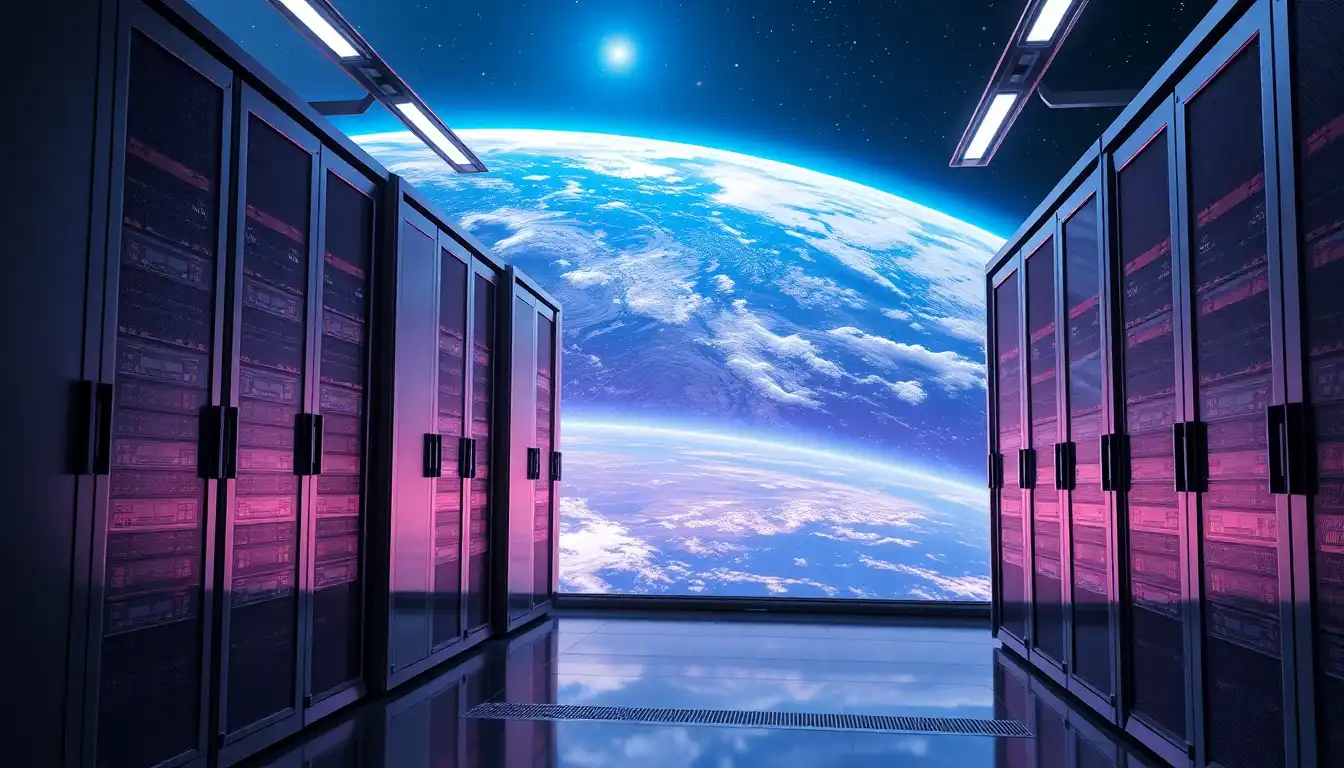
Starcloud just closed a $170 million Series A at a $1.1 billion valuation, making it the fastest Y Combinator company in history to reach unicorn status, just 17 months after demo day. The round, led by Benchmark and EQT Ventures, brings total funding to $200 million for a company that wants to put GPU clusters into low Earth orbit. The obvious reaction is to call this science fiction backed by venture capital exuberance. The more interesting reaction is to ask why some of the sharpest investors in technology think the math might actually work. The answer has less to do with space and everything to do with the terrestrial energy crisis that is strangling AI infrastructure buildout on the ground.
The Power Wall That Nobody Can Climb
The International Energy Agency now projects global data center electricity consumption will hit 1,100 terawatt-hours in 2026, equivalent to Japan's entire national consumption and an 18% upward revision from estimates published just four months earlier. In the United States, the bottleneck is not demand or capital. It is the physical grid. Transformers, the critical hardware connecting new generation capacity to transmission infrastructure, now carry lead times of two to four years. PJM Interconnection, the regional grid operator covering much of the eastern U.S., attributes roughly 7.9 gigawatts of additional data center demand in the current planning cycle, with capacity costs across the region doubling as a result.
Virginia, the world's densest data center market, now dedicates one in every five kilowatt-hours produced by its largest utility to data center operations. Electricity costs have risen 42% since 2019, according to a March 2026 Brookings Institution report, significantly outpacing inflation. The Energy Information Administration confirmed that average retail electricity rates increased more than 5% year-over-year through early 2026.
This is the structural force behind Starcloud's pitch. The company is not primarily selling "space" as a feature. It is selling unconstrained energy. In orbit, solar irradiance delivers roughly 1,361 watts per square meter with zero atmospheric losses, no permitting battles, no grid interconnection queue, and no neighbors filing NIMBY lawsuits. The argument is straightforward: if you cannot build fast enough on the ground because the grid is the bottleneck, build somewhere the grid does not apply.
The Physics of Orbital Compute
Running high-performance GPUs in space is not the same as running Starlink routers. Starcloud launched its first satellite, Starcloud-1, in November 2025 with a single Nvidia H100 GPU, which Nvidia claimed represented 100x more powerful compute than anything previously operated in orbit. The company demonstrated two firsts: training a large language model in space and running a version of Google's Gemini model off-planet. These are genuine technical milestones, but they are proof-of-concept milestones, not production infrastructure.
The engineering challenges are severe and specific. Thermal management in space is fundamentally different from terrestrial cooling. On Earth, you dump heat into air or water. In orbit, the only mechanism is radiative cooling, emitting infrared radiation into the void. Starcloud has adapted cooling technology from the International Space Station, but the ISS dissipates roughly 70 kilowatts of heat. A meaningful GPU cluster running Nvidia Blackwell chips would need to reject megawatts. Scaling radiative cooling by orders of magnitude requires enormous radiator surface areas, which adds mass, which adds launch cost.
Radiation hardening presents another constraint. The space environment bombards electronics with high-energy particles that cause bit flips in memory and logic circuits. Consumer GPUs like the H100 were not designed for this environment. Starcloud uses radiation shielding, but shielding adds mass. The alternative is redundancy and error correction, which costs compute cycles. Either way, the effective performance per kilogram of orbital payload is lower than the raw spec sheet suggests.
Latency is the third challenge. Low Earth orbit at roughly 550 kilometers altitude introduces a minimum of 3-4 milliseconds of one-way signal propagation delay, roughly 7-8 milliseconds round-trip before accounting for any processing or routing overhead. For inference workloads that are latency-sensitive, like serving real-time API calls, this is a dealbreaker. For batch training, offline inference, and asynchronous compute jobs, it is tolerable. Starcloud's near-term addressable market is therefore constrained to workloads where latency does not matter but energy cost and availability do. That market is large and growing, but it is not the entire cloud computing stack.
The Starship Variable
Every financial model for orbital data centers lives or dies on one number: the cost per kilogram to orbit. This is where SpaceX's Starship changes the calculus entirely.
Falcon 9 currently delivers payload to low Earth orbit at approximately $2,720 per kilogram on a commercial basis. Starship, with full booster reuse, targets costs between $67 and $200 per kilogram for its 150-metric-ton payload capacity. Even at the conservative end, that is a 10x to 40x reduction. Starcloud is already designing its third-generation spacecraft, Starcloud 3, as a 200-kilowatt, three-ton vehicle specifically architected to deploy from Starship's "PEZ dispenser" satellite deployment system, the same mechanism SpaceX designed for next-generation Starlink launches.
This dependency on Starship is simultaneously Starcloud's greatest advantage and its most acute risk. If Starship achieves the $200/kg price point and weekly launch cadence that SpaceX is targeting for 2026, the economics of orbital data centers shift from speculative to competitive. A three-ton compute satellite at $200/kg costs $600,000 to launch. Amortized over a five-year operational life with orbital refueling or replacement, the launch cost per GPU-hour could become negligible relative to the energy savings.
But Starship's operational cadence remains unproven at scale. SpaceX is targeting Version 3 Starlink deployments beginning in late 2025, ramping to weekly launches by March 2026. If that timeline slips, or if commercial payload availability remains constrained by SpaceX's own Starlink deployment priorities, Starcloud's build schedule compresses. The company has no alternative heavy-lift vehicle. Blue Origin's New Glenn is operational but offers neither the payload capacity nor the projected cost structure that Starship promises. Arianespace and ULA are not price-competitive at any volume.
The Competitive Chessboard
Starcloud is not operating in a vacuum, figuratively speaking. The competitive landscape for orbital and near-orbital compute is filling quickly, and the most dangerous competitors are not other startups.
In January 2026, SpaceX filed plans with the FCC for millions of additional satellites, with explicit language about extending cloud and AI computing capabilities into orbit. SpaceX already operates the largest satellite constellation in history, has its own launch infrastructure, and is building its own AI training capabilities. If SpaceX decides orbital compute is a market worth owning, it can vertically integrate in a way no startup can match: its own rockets, its own satellites, its own ground stations, its own inter-satellite laser links.
Blue Origin announced the TeraWave constellation of approximately 5,400 satellites designed for high-throughput networking for data centers, enterprise, and government customers. Jeff Bezos has publicly expressed interest in space-based data centers, and Blue Origin's relationship with AWS creates an obvious path to offering orbital compute as an extension of Amazon's cloud platform.
Among startups, Lonestar is pursuing space-based data storage with a focus on archival and disaster recovery. Axiom Space is building a commercial space station that could host compute infrastructure. OrbitsEdge has partnered with Hewlett Packard Enterprise to test computing hardware on the International Space Station. None of these have Starcloud's singular focus on GPU compute, but they are establishing orbital computing as a category.
The strategic question for Starcloud is whether being first and focused is enough when your potential competitors include companies with $100 billion-plus in annual revenue and their own launch vehicles. History suggests that first-mover advantage in infrastructure markets is real but fragile. Being the pioneer often means absorbing the cost of proving the market exists, only to watch a larger player scale it.
What the Unicorn Price Tag Actually Means
A $1.1 billion valuation on $200 million in total funding, with one satellite carrying a single H100 in orbit, is not a valuation based on current revenue or even near-term revenue projections. It is a valuation of optionality. Benchmark and EQT are pricing in a world where Starship works, where radiative cooling scales, where the energy crisis on the ground intensifies, and where Starcloud can build orbital capacity faster than hyperscalers can secure terrestrial power purchase agreements.
The founder profile supports the optionality thesis. CEO Philip Johnston brings a McKinsey background focused on satellite projects for national space agencies, combined with degrees spanning national security, applied mathematics, and finance. Chief Engineer Adi Oltean spent 20 years at Microsoft building large production GPU clusters, holds 25 patents, then moved to SpaceX where he led the "tracking beams" system that enables Starlink communication with other spacecraft, including Starship. CTO Ezra Feilden brings a decade of satellite design from Airbus Defence and Space, specializing in deployable solar arrays. This is not a team that stumbled into space from a software background. They have deep domain expertise across every layer of the problem: compute infrastructure, spacecraft engineering, and power systems.
The Y Combinator speed record matters less than people think. Reaching unicorn status in 17 months reflects a fundraising environment where AI infrastructure is the hottest sector in venture capital and where "space" adds narrative premium. The record says more about the market's appetite for AI infrastructure bets than about Starcloud's technical readiness. The real test begins now: can the team convert venture capital into functioning orbital infrastructure before the window closes?
Three Predictions for the Orbital Compute Market
First, Starcloud will face a defining moment in late 2026 or early 2027 when Starcloud 2, carrying multiple GPUs including Nvidia Blackwell chips and an AWS server blade, either demonstrates sustained orbital compute or reveals the scaling limits of current thermal management approaches. The gap between one H100 and a multi-GPU cluster in terms of heat rejection is nonlinear. If Starcloud 2 works, the company's next fundraise will be measured in billions. If thermal management proves harder to scale than projected, the timeline extends by years.
Second, SpaceX will announce its own orbital compute offering within 18 months. The FCC filings, the Starship payload capacity, the existing Starlink ground infrastructure, and the growing AI compute demand inside SpaceX itself all point in one direction. When SpaceX enters, it will offer vertically integrated orbital compute at prices Starcloud cannot match. Starcloud's survival strategy will depend on whether it has established enough of a customer base and enough proprietary technology to justify acquisition rather than competition.
Third, at least one hyperscaler, most likely Microsoft given Adi Oltean's two decades there and the company's existing Azure Space initiative, will sign a strategic partnership with Starcloud before the end of 2027. Hyperscalers need to show investors they have a path to meeting AI compute demand that is not entirely dependent on terrestrial grid capacity. An orbital compute partnership, even one that delivers relatively modest capacity, changes the narrative about infrastructure constraints. For Microsoft specifically, the combination of Azure's cloud platform, SpaceX's Starlink partnership for ground connectivity, and Starcloud's orbital hardware creates a compelling end-to-end story.
The question behind Starcloud is not really whether data centers in space are possible. The satellite in orbit already answers that. The question is whether they can be economical at scale before the terrestrial energy crisis resolves itself through nuclear buildout, grid modernization, or efficiency gains. Starcloud is betting that the grid moves slower than rockets. Given the two-to-four-year transformer lead times, the permitting battles, and the sheer scale of projected demand, that bet is more rational than it sounds.