
DC Circuit Upholds Pentagon Supply-Chain Label on Anthropic
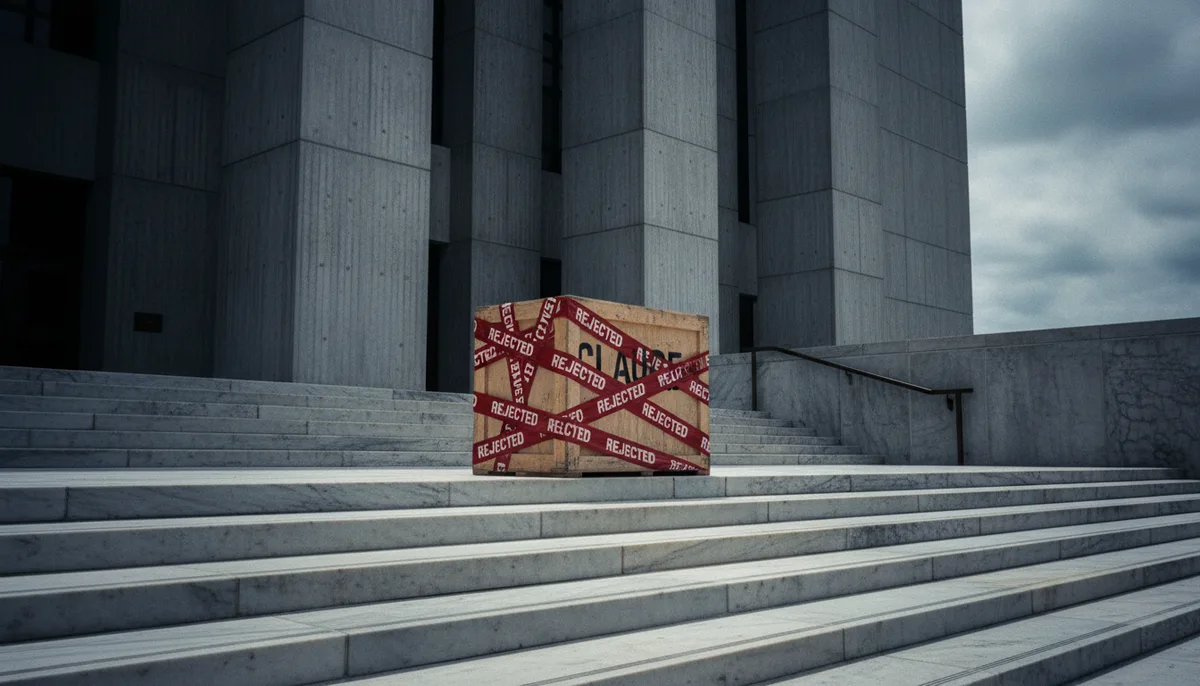
Illustration, not documentary evidence of the event.
A federal appeals court in Washington, DC, on Friday upheld one of the two supply-chain risk designations the Department of Defense placed on Anthropic earlier this year, according to Wired. The panel split 2-1, and the majority declined to overrule the Trump administration's judgment that keeping Claude inside Pentagon systems posed a national security risk covered by statute.
The majority opinion leaned on Anthropic's own position to justify the label. The judges wrote that the department "had ample support for its conclusion" and pointed out that, as Anthropic itself acknowledges, the company builds restrictions into Claude that stop the model from doing things Anthropic wants to prevent. Anthropic spokesperson Danielle Cohen told Wired the company remains confident in its position and is weighing all options, which could include seeking review from the full DC Circuit or the Supreme Court.
A split result across two courts
The Pentagon used two separate supply-chain laws to push Claude out of the military and other parts of the federal government by this month, per Wired's account. Because the laws had to be challenged in different courts, the outcomes diverged. A federal judge in San Francisco threw out one designation in March and reaffirmed that decision last month. Friday's DC ruling leaves the other designation standing indefinitely, so the Pentagon's exclusion of Anthropic continues regardless of the San Francisco result. Wired notes both rulings could face years of further appeals.
The underlying dispute traces back to Anthropic's refusal to let the government use its current models for autonomous weapons or domestic surveillance. Defense Secretary Pete Hegseth called that stance a significant national security risk. The DC majority also rejected Anthropic's due process and free speech claims, characterizing the fight as ordinary contract negotiation. The judges wrote that the department excluded Anthropic over its refusal to accept a contract term the Pentagon considered essential, not over the company's advocacy for more AI regulation.
The ruling was not a surprise. Wired reports the same three-judge panel refused in April to temporarily halt the designation, finding Anthropic had not met the "stringent requirements" for emergency relief, though the judges appeared divided at oral argument.
What the reasoning means for anyone building on AI
The most consequential part of this ruling, in my reading, is not the outcome but the logic. The majority treated the safeguards Anthropic encodes into Claude as evidence supporting the risk finding. That reframes a model's built-in refusals from a product feature into a procurement liability, at least where a government buyer wants capabilities the vendor will not provide. If that framing holds, every lab that ships a model with hard limits on certain uses has to decide whether those limits are negotiable when a large buyer demands otherwise. The court's answer here was that the government can walk away and label the vendor a risk for saying no.
The open question is whether this is really about contracts or about speech, and the two courts appear to have read the same facts differently. The DC majority said contract term, full stop. The San Francisco court tossed the parallel designation, though Wired does not detail that judge's reasoning. A dissent on the DC panel and a contrary district court result give Anthropic something to work with on further appeal, but Wired's reporting suggests any final resolution is years away. In the meantime, the practical effect is the same as a loss.
For Anthropic, timing is the sharper concern. Wired reports the company is moving toward a potential IPO later this year and has publicly emphasized growing sales, while offering no updates on the revenue hit it initially attributed to being treated as a government pariah. Prospective investors will presumably want to know how much federal and federal-adjacent business is off the table for the foreseeable future. That figure has not been disclosed, based on Wired's account, and I would watch any offering documents closely for it.
The other thing to watch is whether the Pentagon has actually replaced Claude. Wired says the department has not provided detailed progress reports on swapping in alternatives such as SpaceX's Grok, Google's Gemini, or OpenAI's GPT models. Employees at Google and OpenAI have objected to their companies taking the deal Anthropic refused, but leadership at both firms has dismissed those protests and framed supporting the government as essential. If the migration is slow or incomplete, the risk designation is less a clean severing than a standoff, and that would matter for how the appeals play out and for how competitors position themselves in the gap.