

Poolside's Radical Transparency Play
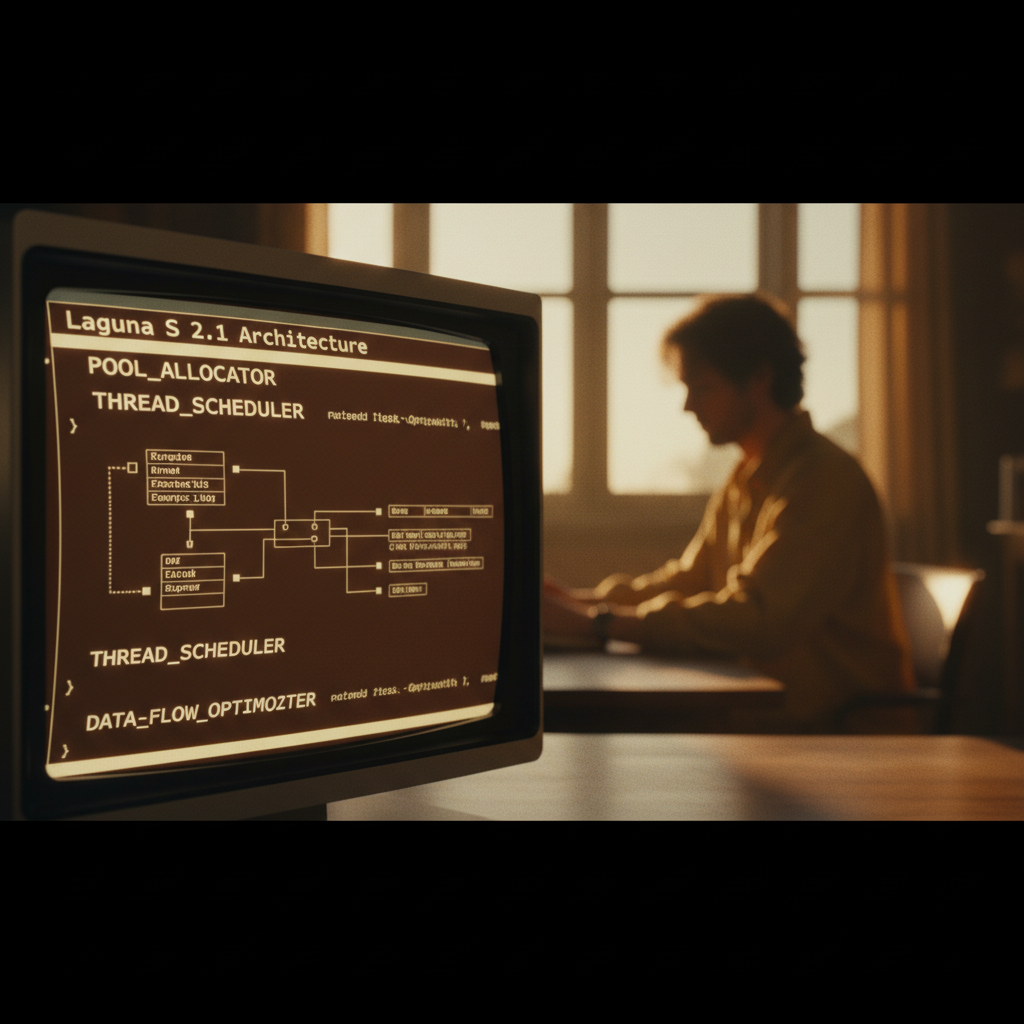
Illustration, not documentary evidence of the event.
Poolside's decision to release Laguna S 2.1, a 118-billion-parameter Mixture-of-Experts (MoE) system, marks a bold departure from the traditional approach to AI development, where scale is often seen as the primary driver of performance. By activating only 8 billion parameters per token and supporting a context window of up to 1, Laguna S 2.1 achieves remarkable efficiency without sacrificing capability. AI offers additional context on this topic.
Technical Deep Dive
Laguna S 2.1's MoE architecture is a crucial factor in its ability to outperform larger models. By dynamically assigning parameters to specific tasks, the model can focus its computational resources on the most critical aspects of the input data, resulting in significant performance gains. The use of a sparse attention mechanism further enhances efficiency, allowing the model to selectively weigh the importance of different input elements. Mixture-of-Experts offers additional context on this topic.
A key technical challenge in implementing MoE models is ensuring that the parameter allocation is optimal for each task. Poolside's solution involves a novel combination of reinforcement learning and gradient-based optimization, which enables the model to adapt its parameter allocation strategy in real-time. This approach not only improves performance but also reduces the risk of overfitting, as the model is less likely to become overly specialized to a particular task or dataset.
Industry Impact
The release of Laguna S 2.1 has significant implications for the AI industry, as it challenges the conventional wisdom that larger models are necessarily better. By demonstrating that radical transparency and efficient architecture can be more effective than brute scale, Poolside is poised to disrupt the status quo and potentially upend the competitive landscape. Rivals will need to reassess their development strategies and consider the benefits of adopting more transparent and efficient approaches. AI offers additional context on this topic.
From a market perspective, Laguna S 2.1's open-weight design and transparent architecture make it an attractive option for organizations seeking to develop customized AI solutions. The model's ability to be fine-tuned for specific tasks and datasets reduces the risk of vendor lock-in, allowing users to maintain greater control over their AI deployments. As a result, Poolside is likely to attract a significant following among organizations seeking to leverage AI for competitive advantage. AI offers additional context on this topic.
Competitive Analysis
Laguna S 2.1's performance is particularly notable when compared to larger models from established players. While these models may boast impressive parameter counts, their lack of transparency and efficiency often results in suboptimal performance. In contrast, Laguna S 2.1's MoE architecture and sparse attention mechanism enable it to achieve state-of-the-art results while using significantly fewer resources. This has significant implications for the competitive landscape, as Poolside's model is likely to appeal to organizations seeking to minimize their AI footprint while maximizing performance. AI offers additional context on this topic.
A key differentiator for Poolside is its focus on radical transparency, which enables the company to provide unparalleled visibility into its models' decision-making processes. This is particularly important for high-stakes applications, such as healthcare or finance, where the ability to understand and explain AI-driven decisions is critical. By prioritizing transparency, Poolside is well-positioned to capitalize on the growing demand for trustworthy and explainable AI solutions. For related analysis, see GPU Relief: Weka's Storage Breakthrough for AI Workloads. For related analysis, see AMD's $5 Billion Bet on Anthropic AI. For related analysis, see AI Agents Fail Due to Bad Data Engineering. For related analysis, see Anthropic's Claude Voice Mode Upgrade: A New Era for Conversational AI. For related analysis, see AMD Takes Aim at Nvidia with Helios AI Rack-Scale System. For related analysis, see AI Lab Prentis Aims To Automate Routine Tasks. For related analysis, see Microsoft AI Models Slash Costs. For related analysis, see China's AI Gambit: Giving Away Top Models. For related analysis, see Anthropic CEO Weighs In On Open-Weight Models And China's AI Rise. For related analysis, see Fish Audio's $52M Seed Fuels AI Voice Revolution. For related analysis, see GM's AI-Driven Engineering Workflow Redesign: A New Era for Autonomous Vehicle Development. For related analysis, see Waymo's AI Evaluation Strategy: A New Standard for High-Stakes Deployments. For related analysis, see Enterprise AI Agents Need Infrastructure Overhaul. For related analysis, see Thinking Machines' Inkling Small: A New Era in Open Source AI. For related analysis, see AI Data Pipelines Lag Behind Free-Form Code. For related analysis, see AI Disrupts Math: Can Human Intuition Survive?. For related analysis, see OpenAI Presence Revolutionizes AI Agents for Businesses. For related analysis, see Design Arena Secures $7.9 Million to Infuse AI Models with Human Taste. For related analysis, see Open-Weight AI Safety Gap Widens as Capabilities Surge. For related analysis, see Liquid AI's LFM2.5-2.6B Model Redefines Edge AI. For related analysis, see AI Predicts Hurricanes Earlier. For related analysis, see Cloudflare Kitesurf: Efficient AI Browser. For related analysis, see Stanford's AI Biotech Breakthrough: 37,000 Agents Redefine Collaboration. For related analysis, see River AI's $1.1B Raise Redefines AI Startup Landscape.
Frequently Asked Questions
How does Laguna S 2.1's MoE architecture contribute to its performance?
Laguna S 2.1's MoE architecture enables the model to dynamically allocate parameters to specific tasks, resulting in significant performance gains. By focusing its computational resources on the most critical aspects of the input data, the model can achieve state-of-the-art results while using significantly fewer resources.
What are the implications of Poolside's radical transparency approach for the AI industry?
Poolside's focus on radical transparency has significant implications for the AI industry, as it challenges the conventional wisdom that larger models are necessarily better. By demonstrating that transparent and efficient approaches can be more effective than brute scale, Poolside is poised to disrupt the status quo and potentially upend the competitive landscape.
How does Laguna S 2.1's open-weight design impact its customization and fine-tuning capabilities?
Laguna S 2.1's open-weight design and transparent architecture make it an attractive option for organizations seeking to develop customized AI solutions. The model's ability to be fine-tuned for specific tasks and datasets reduces the risk of vendor lock-in, allowing users to maintain greater control over their AI deployments. Our AI safety analysis explores this further.
What are the potential applications of Laguna S 2.1 in industries such as healthcare or finance?
Laguna S 2.1's focus on radical transparency and explainability makes it an attractive option for high-stakes applications, such as healthcare or finance. By providing unparalleled visibility into its decision-making processes, Poolside's model can help organizations build trust in their AI deployments and ensure that they are making informed, data-driven decisions.
As the AI landscape continues to evolve, it is likely that we will see a shift towards more transparent and efficient approaches. Poolside's Laguna S 2.1 is a significant step in this direction, and its impact will be felt across the industry. With its MoE architecture, sparse attention mechanism, and radical transparency approach, Laguna S 2.1 is poised to challenge the status quo and establish a new standard for AI development. Our AI development analysis explores this further.